

Most people do blood tests, glance at the word normal, and move on. That is understandable, but it also means many people miss one of the most useful preventive-health tools available to them. Routine bloodwork can reveal early clues about blood sugar control, cardiovascular risk, thyroid function, iron status, recovery capacity, inflammation patterns, hydration, and organ health long before a major problem becomes obvious.
That is why this topic deserves a place on FitOnear. The site already covers smart wearables, glucose tracking, circadian rhythm, hormonal balance, hydration, and personalized nutrition. What it does not yet cover in a direct, practical, beginner-friendly way is the bridge between those topics and the lab panel many people already have access to through annual exams. This article fills that gap.
The goal here is not to help you self-diagnose. The goal is to help you become a more informed participant in your own health. If you understand what the main markers generally reflect, you can ask better questions, spot lifestyle patterns earlier, and make your discussions with a qualified clinician more useful.
Important note: Lab interpretation always depends on context. Reference ranges vary by laboratory, and the meaning of a result depends on your symptoms, medications, age, sex, training load, body composition, sleep, stress, and medical history. Use this guide for education, not diagnosis.
Why routine bloodwork matters more than ever
In a world full of health content, it is easy to focus only on supplements, gadgets, and optimization trends. But routine bloodwork remains one of the most practical starting points because it measures what is happening inside the body rather than what we assume is happening. A standard preventive panel can help identify patterns related to metabolic health, anemia, kidney strain, liver stress, thyroid imbalance, and cardiovascular risk.
For example, the same person who is struggling with afternoon crashes may discover that the real issue is not motivation but iron deficiency, poor blood sugar control, under-recovery, or thyroid dysfunction. Someone else who feels “mostly fine” may learn that LDL cholesterol, triglycerides, fasting glucose, or liver enzymes are moving in the wrong direction. These are precisely the kinds of signals that matter if your goal is not only performance, but also longevity with quality of life.
If you have already explored FitOnear’s article on continuous glucose monitoring, this guide will give you the broader clinical context behind glucose-related data. It also pairs naturally with the site’s pieces on personalized nutrition, hormonal harmony, and hydration.
The big idea: look for patterns, not isolated numbers
One of the most common mistakes people make is overreacting to a single marker. A lone number rarely tells the whole story. Bloodwork becomes more useful when you view it as a pattern.
| Pattern | What it may suggest | Why context matters |
| Higher fasting glucose or HbA1c | Blood sugar regulation may be worsening | Sleep loss, stress, illness, medications, and diet can affect results |
| Low hemoglobin with low ferritin | Iron deficiency may be contributing to fatigue or poor performance | Menstrual losses, diet quality, gut issues, and endurance training all matter |
| High triglycerides with low HDL | Metabolic risk may be rising | Alcohol intake, refined carbohydrate load, insulin resistance, and inactivity may contribute |
| Elevated ALT or AST | Liver stress, medication effects, or intense exercise recovery issues may be present | Exercise, alcohol, fatty liver, and supplements can all influence enzymes |
| Abnormal TSH | Thyroid regulation may need further evaluation | Additional thyroid tests are often needed to understand the cause |
This is why the best mindset is to treat your lab report like a map rather than a verdict.
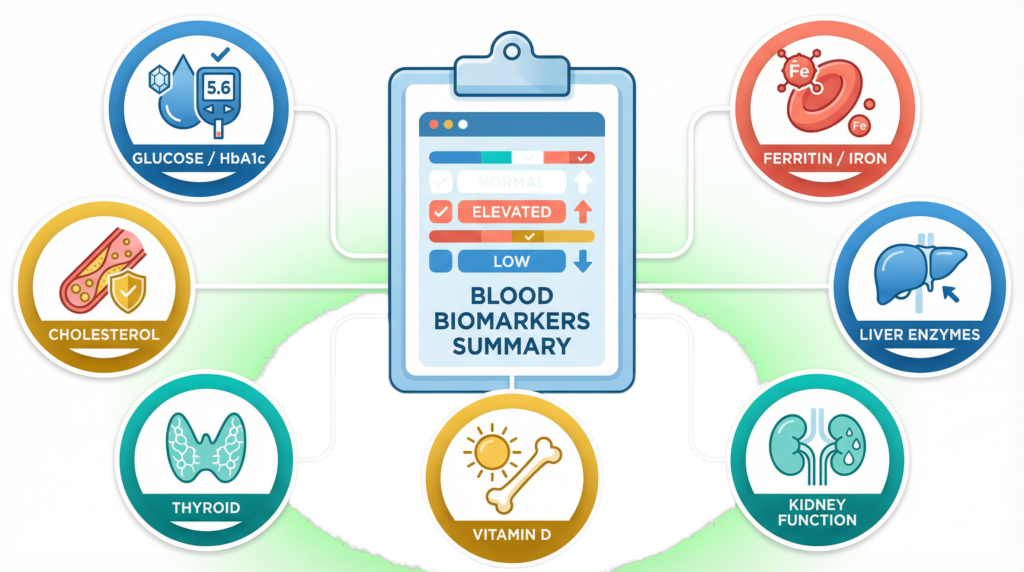
The 10 biomarkers that matter most for everyday health
Below is a practical framework for the markers that give the average person the most useful information. Some appear in nearly every routine panel. Others are worth discussing with your clinician if your symptoms, family history, or goals make them relevant.
| Biomarker | What it broadly reflects | Why it matters |
| CBC | Blood cell counts and blood composition | Can reveal anemia, infection patterns, clotting issues, or dehydration |
| HbA1c | Average blood sugar over roughly 3 months | Helps identify normal glycemia, prediabetes, or diabetes risk |
| Fasting glucose | Blood sugar at one point in time | Useful alongside HbA1c and lifestyle context |
| Lipid panel | Total cholesterol, LDL, HDL, triglycerides | Helps assess cardiovascular risk patterns |
| Ferritin | Stored iron | Useful in fatigue, hair loss, reduced performance, or heavy menstrual loss |
| TSH | Thyroid signaling from the pituitary to the thyroid | Can flag thyroid patterns affecting energy, mood, weight, and recovery |
| Creatinine / BUN | Kidney filtration and nitrogen waste handling | Important for hydration, kidney health, and context around high-protein intake |
| ALT / AST / bilirubin | Liver-related enzymes and liver processing | Can reflect liver stress, medication effects, or sometimes heavy training load |
| Electrolytes | Sodium, potassium, bicarbonate, chloride | Help reflect fluid balance and metabolic stability |
| Vitamin D | Vitamin D status, usually measured as 25(OH)D | Context-dependent but useful in bone health and deficiency risk |
1. Complete blood count (CBC)
The complete blood count, or CBC, is one of the most common blood tests and is often part of a routine checkup. It includes markers such as red blood cells, white blood cells, platelets, hemoglobin, hematocrit, and MCV. In simple terms, it helps answer whether your blood is carrying oxygen well, whether your immune system looks unusually activated or suppressed, and whether clotting-related cell counts appear normal.
For everyday readers, the biggest practical value of the CBC is that it can flag patterns related to anemia, infection, bleeding, dehydration, or abnormal blood cell production. If you feel persistently tired, lightheaded, short of breath, or less resilient in training, the CBC is often one of the first places to look.
A very common scenario is this: someone assumes they need more caffeine, but a CBC shows low hemoglobin or hematocrit, which then leads to checking ferritin and iron status more closely. That is a good example of why basic bloodwork often provides more value than guesswork.
2. HbA1c
HbA1c is one of the most useful markers in preventive health because it reflects your average blood sugar over roughly the last three months. According to the CDC, an A1c below 5.7% is considered normal, 5.7% to 6.4% indicates prediabetes, and 6.5% or above is in the diabetes range.
This marker matters even if you do not think of yourself as someone with a blood sugar issue. Poor sleep, excess body fat, chronic stress, low activity, poor meal composition, and a high intake of ultra-processed foods can all push glucose regulation in the wrong direction over time. If you enjoyed FitOnear’s article on CGMs and real-time blood sugar biofeedback, HbA1c is the longer-view marker that shows what those daily patterns may be adding up to.
3. Fasting glucose
Fasting glucose is a snapshot rather than a long-term average. It tells you what your blood sugar looked like at the specific moment the sample was drawn, often after fasting overnight. That makes it useful, but it is strongest when interpreted with HbA1c, sleep quality, recent stress, activity level, and even illness.
If fasting glucose is repeatedly drifting upward, that can be a signal to review meal timing, carbohydrate quality, stress load, exercise consistency, and sleep regularity. It is also where lifestyle tracking and lab testing complement each other well.
4. Lipid panel: LDL, HDL, total cholesterol, and triglycerides
A lipid panel gives you a clearer picture of cardiovascular risk than total cholesterol alone. According to the CDC and NHLBI, it typically includes LDL cholesterol, HDL cholesterol, triglycerides, and total cholesterol. In broad terms, higher LDL can contribute to plaque buildup in the arteries, HDL plays a protective role, and elevated triglycerides often point toward metabolic imbalance, especially when paired with low HDL.
The practical question is not whether one number is “good” or “bad” in isolation. The better question is whether the lipid pattern matches your overall lifestyle. High triglycerides, for example, often deserve a hard look at alcohol, sleep, refined carbohydrate intake, insulin resistance, and physical inactivity. This is also where FitOnear’s pieces on nutrition and biomarkers and cardio-supportive recovery habits become more meaningful when paired with actual lab data.
5. Ferritin
Ferritin is one of the most overlooked markers in routine health conversations, especially for women, endurance athletes, vegetarians, and anyone with chronic fatigue. MedlinePlus explains that ferritin reflects stored iron in the body. Low ferritin may suggest iron deficiency, while high ferritin can occur with inflammation, liver disease, obesity, alcohol use disorder, hyperthyroidism, or iron overload states.
This matters because iron-related symptoms can be deceptively broad. Low iron may show up as poor exercise tolerance, dizziness, fatigue, restless legs, pale skin, hair shedding, or simply feeling “off.” At the same time, high ferritin is not automatically a sign that you have too much iron; it can also behave like an inflammation-related marker in some settings. That is why ferritin works best when interpreted alongside CBC results, symptoms, medical history, and sometimes fuller iron studies.
6. TSH
TSH, or thyroid-stimulating hormone, is a blood test used to assess how well your thyroid system is functioning. Thyroid hormones influence energy use, heart rate, digestion, mood, temperature tolerance, and body weight regulation. In other words, thyroid status affects many of the same areas people often try to “biohack.”
A TSH result that is high or low may suggest a thyroid issue, but it does not explain the full cause on its own. Additional testing may include T4, T3, or thyroid antibodies depending on the situation. From a practical standpoint, thyroid testing becomes especially relevant if you have unexplained fatigue, weight changes, feeling unusually cold, hair thinning, constipation, palpitations, or menstrual irregularities.
If you have already read FitOnear’s article on endocrine optimization and hormonal harmony, routine thyroid testing is one of the most grounded ways to move that conversation from theory into measurable physiology.
7. Creatinine and BUN
Creatinine and blood urea nitrogen, or BUN, are part of the metabolic panel and help reflect how well the kidneys are filtering waste from the blood. These markers matter not only in overt kidney disease, but also in the interpretation of hydration, recovery, high-protein diets, and supplement-heavy routines.
This is where context becomes critical. A muscular person with a high protein intake may not interpret exactly the same way as a sedentary person with the same number. Dehydration can also influence kidney-related markers. That is one reason why bloodwork should be reviewed as a whole, not in isolation.
8. ALT, AST, and bilirubin
ALT and AST are liver-related enzymes, while bilirubin is a waste product processed largely through the liver. These markers often appear on a comprehensive metabolic panel. When they are elevated, it may indicate liver stress, medication effects, alcohol-related strain, fatty liver patterns, or other issues that deserve attention.
However, context matters here too. Intense training can sometimes affect enzyme readings, which is one reason athletes and highly active people should avoid drawing broad conclusions without professional interpretation. The value of these markers lies in early visibility. If they are trending away from baseline, they can prompt a timely review of nutrition quality, alcohol intake, medication burden, supplement use, and body composition trends.
9. Electrolytes: sodium, potassium, bicarbonate, and chloride
Electrolytes do not usually get the same attention as cholesterol or glucose, but they are fundamental to fluid balance, nerve signaling, muscle function, and acid-base balance. If you sweat heavily, train hard, use saunas, follow a restrictive diet, or have gastrointestinal issues, electrolyte context can become particularly important.
This topic connects naturally with FitOnear’s article on hydration and performance. Hydration is not just about drinking more water. It is about maintaining the right internal balance.
10. Vitamin D
Vitamin D is slightly different from the other markers in this article because routine testing is not recommended for everyone. MedlinePlus notes that most vitamin D tests measure 25-hydroxyvitamin D, or 25(OH)D, which is the best indicator of vitamin D status. Testing may be more appropriate if you have symptoms of deficiency, low bone density, fracture risk, limited sun exposure, malabsorption issues, or certain medical conditions and medications.
That nuance matters. Good preventive health is not about ordering every possible test. It is about choosing the right test for the right context.
A simple way to think about your results
Instead of obsessing over one line on your report, use this three-part framework.
| Question | What to ask yourself | Why it helps |
| What system does this marker belong to? | Is this blood sugar, thyroid, iron, liver, kidney, or cardiovascular? | It stops you from reacting emotionally to a number without understanding the system |
| Is there a pattern across multiple markers? | Do several results point in the same direction? | Patterns are usually more meaningful than isolated values |
| Does it match how I feel and live? | Do the results fit my symptoms, sleep, diet, stress, training, and recovery? | Labs become more useful when connected to real life |
For example, if fatigue shows up alongside low hemoglobin, low ferritin, and reduced training tolerance, that tells a more coherent story than fatigue alone. If poor sleep, weight gain around the waist, rising triglycerides, and a worsening HbA1c appear together, that creates another useful pattern.
When bloodwork should lead to a real conversation with a clinician
Some people use lab data as reassurance. Others use it as a reason to panic. Neither approach is ideal. The better approach is to use abnormal or changing results as a reason for a more informed conversation.
You should be especially proactive about follow-up if you have persistent fatigue, unexplained weight change, dizziness, unusual shortness of breath, strong family history of diabetes or heart disease, severe menstrual losses, significant hair loss, new digestive issues, or any lab value that is clearly abnormal or worsening over time. The same applies if multiple markers are trending unfavorably even while still technically inside reference range.
That is also why keeping copies of your results over time is so valuable. Trends often matter more than a single snapshot.
What you can improve before your next blood test
The most empowering part of bloodwork is that many markers respond to lifestyle change. Not all, but many.
| Area | Actions that may support healthier trends |
| Blood sugar | More walking, better sleep consistency, higher protein meals, more fiber, lower ultra-processed intake |
| Lipids | More whole foods, reduced alcohol excess, higher activity, better weight management, more omega-3-rich foods |
| Ferritin / iron-related issues | Review dietary iron intake, menstrual losses, recovery load, and discuss proper testing before supplementing |
| Liver-related markers | Reduce alcohol, improve body composition, review medications and unnecessary supplements with a clinician |
| Kidney and hydration markers | Improve hydration habits, review training load, and make sure high-protein strategies are individualized |
| Thyroid support context | Prioritize energy adequacy, stress management, sleep, and appropriate medical review rather than self-experimentation |
This is where lab testing becomes extremely practical. It gives you a way to connect what you do every day with objective feedback over time.
If you are trying to build a stronger health baseline, you may also find it helpful to combine bloodwork interpretation with FitOnear’s guidance on sleep and circadian rhythm, nervous system regulation, and gut-health-informed nutrition.
The bottom line
If there is one takeaway from this article, it is this: routine bloodwork is not just for diagnosing disease. It is one of the most useful tools for prevention, self-awareness, and smarter lifestyle decisions.
You do not need to become your own doctor. But you should understand enough to recognize the difference between noise and signal. A CBC can highlight anemia or abnormal blood cell patterns. HbA1c and fasting glucose can reveal the direction of your metabolic health. A lipid panel can uncover cardiovascular risk patterns. Ferritin can explain why you feel more drained than your schedule alone would suggest. TSH can give early clues about thyroid function. A metabolic panel can reveal important information about liver, kidney, electrolyte, and protein status.
That is what makes this topic so necessary. It is useful for beginners, athletes, busy professionals, parents, and anyone who wants to stay healthier longer.
FAQ: routine bloodwork explained simply
What blood tests should I ask for in a routine annual checkup?
A preventive panel commonly includes a CBC, lipid panel, glucose-related testing, and either a basic or comprehensive metabolic panel. Depending on your symptoms or risk factors, your clinician may also consider HbA1c, TSH, ferritin, iron studies, or vitamin D.
Is one abnormal result always a sign of disease?
No. A result can be influenced by hydration, illness, medications, sleep, stress, menstrual status, recent exercise, supplements, and lab-specific reference ranges. That is why one isolated number should not be overinterpreted.
Is vitamin D testing necessary for everyone?
No. MedlinePlus specifically notes that routine vitamin D testing is not recommended for everyone. It is most useful when there are symptoms, risk factors, or medical reasons to check it.
Can exercise affect bloodwork?
Yes. Heavy or recent training can affect certain results, including hydration-related markers and sometimes liver-associated enzymes. This is one reason it helps to interpret labs with your training context in mind.
References
[1] MDVIP: Most Important Preventive Health Blood Tests
[2] CDC: The A1C Test & Diabetes
[3] CDC: Testing for Cholesterol
[4] MedlinePlus: Ferritin Blood Test
[5] MedlinePlus: TSH (Thyroid-stimulating hormone) Test
[6] MedlinePlus: Comprehensive Metabolic Panel (CMP)