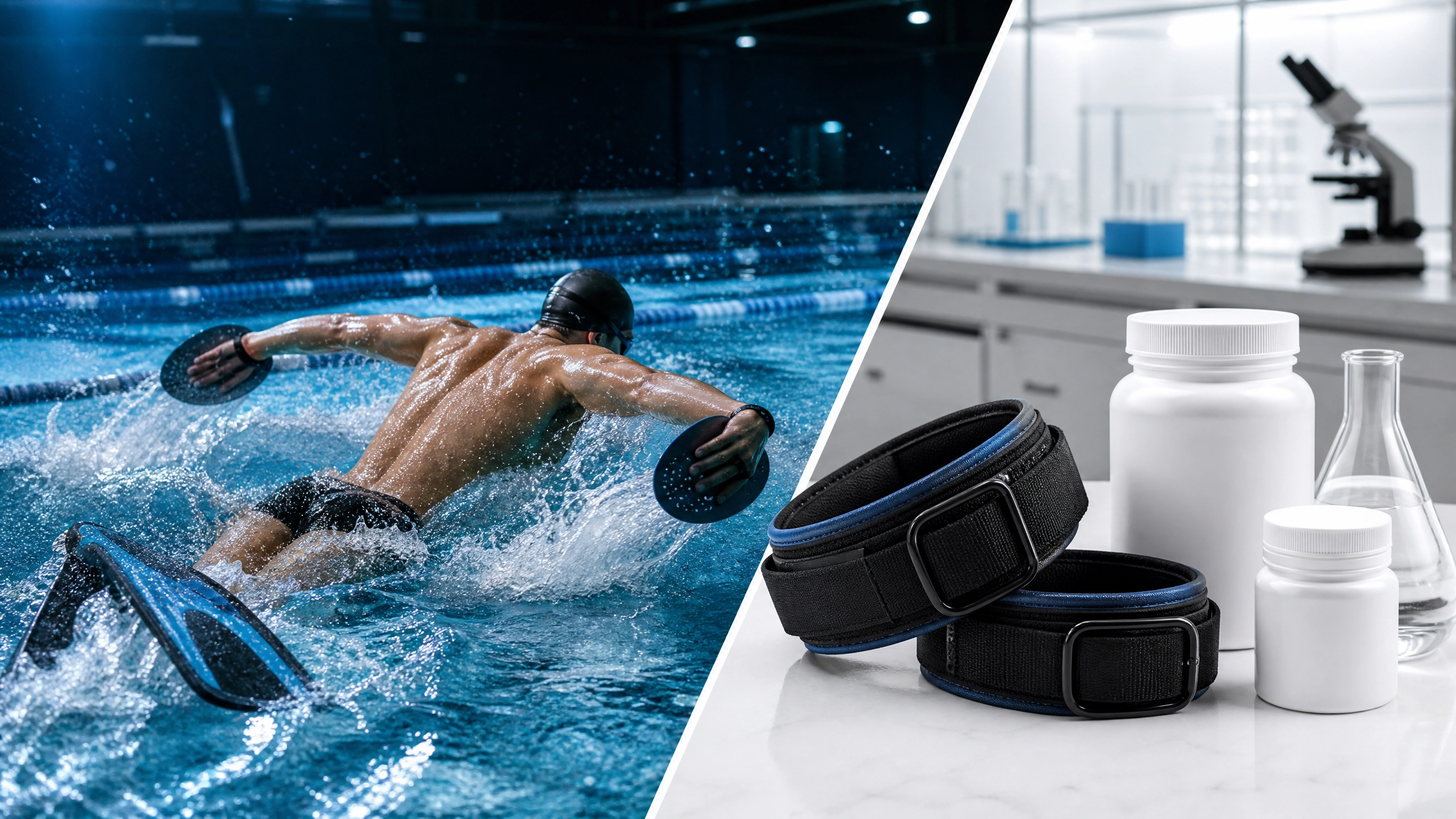
Hey there! It sounds like you have a solid foundation with a well-developed chest, but you’re looking to bring your arms, legs, and hips up to speed to achieve a more balanced, powerful physique. This is a common challenge, but the good news is that with the right approach, you can absolutely build strength and size in those lagging areas.
This comprehensive guide will walk you through specialized swimming workouts, targeted nutrition strategies, and cutting-edge biohacking tips to help you achieve that balanced, athletic body you’re aiming for. We’ll focus on maximizing muscle hypertrophy (growth) in your limbs and hips while maintaining your current chest development.
1. Swimming Workouts for Arm, Leg, and Hip Hypertrophy
Swimming is often thought of as purely cardiovascular exercise, but with the right techniques and equipment, it can be a highly effective resistance training tool. Water is roughly 800 times denser than air, providing constant, accommodating resistance [1]. To build muscle, we need to increase the resistance and focus on specific drills.
Lower Body Focus: Legs and Hips
To target your weak legs and hips, you need to isolate them and force them to work harder against the water’s resistance.
- Vertical Kicking: This is a brutal but incredibly effective drill for building leg and hip strength. Instead of swimming horizontally, you tread water in a vertical position using only your kick (flutter or dolphin kick). Keep your hands out of the water (or even hold a weight) to increase the difficulty. A great set is 10 rounds of 45 seconds on, 15 seconds off [2].
- Kickboard Sets with Fins: Using a kickboard isolates your lower body. Adding training fins increases the surface area of your foot, which significantly increases the resistance and the workload on your quads, hamstrings, and glutes [3]. Focus on powerful, explosive kicks from the hips, not just the knees.
- Parachute or Drag Sox Kicking: For advanced resistance, you can use a swimming parachute or “Drag Sox” (mesh bags worn over the feet). These create massive drag, forcing your legs and hips to work overtime to propel you forward.
Upper Body Focus: Arms
Since your chest is already well-developed, we want to focus on isolating the biceps, triceps, and shoulders during your swim.
- Pull Buoy with Hand Paddles: Place a pull buoy between your thighs to float your legs, completely isolating your upper body. Then, wear hand paddles. Paddles increase the surface area of your hands, pulling more water and creating significant resistance for your arms and shoulders [4]. Focus on the “catch” and “pull” phases of the stroke, squeezing the triceps at the back of the stroke.
- Fists Closed Swimming: Swim freestyle with your hands balled into fists. This removes the surface area of your hands, forcing your forearms and upper arms to work much harder to generate propulsion.
- Water Jogging with Arm Sweeps: In the shallow end, perform water jogging while aggressively sweeping your arms back and forth under the water. The resistance of the water will work your biceps and triceps.
2. Biohacking Tips for Muscle Balance and Recovery
Biohacking involves using science and technology to optimize your body’s performance and recovery. Here are some powerful biohacking strategies to help you build muscle in your weak areas.
Blood Flow Restriction (BFR) Training
Blood Flow Restriction (BFR) training is a game-changer for building muscle, especially if you want to avoid heavy lifting that might overtax your joints. BFR involves wrapping a specialized band around the top of your arms or legs to restrict venous blood flow out of the muscle while allowing arterial blood flow in [5].
This creates a hypoxic (low oxygen) environment in the muscle, which triggers a massive release of growth hormone and stimulates muscle hypertrophy even when using very light weights or doing bodyweight exercises [6]. You can incorporate BFR bands into your dryland training (e.g., light squats, lunges, bicep curls, tricep extensions) to specifically target your arms and legs.
Contrast Therapy (Hot/Cold Exposure)
Optimizing recovery is just as important as the workout itself. Contrast therapy involves alternating between hot and cold environments. For example, spending 15 minutes in an infrared sauna followed by 3 minutes in a cold plunge or ice bath [7].
The heat dilates blood vessels, promoting blood flow and nutrient delivery to recovering muscles. The cold constricts blood vessels, flushing out metabolic waste products like lactic acid and reducing inflammation. This rapid vasodilation and vasoconstriction act like a pump, accelerating the recovery process so you can train harder and more frequently.
Sleep Optimization
Muscle growth happens when you sleep, not when you train. Deep sleep is when your body releases the majority of its human growth hormone (HGH). To biohack your sleep:
- Keep your room cold (around 65°F or 18°C).
- Block out all light (use blackout curtains and a sleep mask).
- Avoid blue light from screens for at least an hour before bed.
- Consider a magnesium supplement (more on this below) to promote relaxation.
3. Targeted Nutrition and Supplementation
To build muscle in your arms and legs, you need to be in a slight caloric surplus (eating more calories than you burn) and consuming adequate protein. Aim for roughly 0.8 to 1 gram of protein per pound of body weight daily.
Here are the top supplements to support your goals:
Creatine Monohydrate
Creatine is one of the most researched and effective supplements for increasing muscle mass and strength [8]. It works by increasing the availability of ATP (cellular energy), allowing you to push harder during your swimming sprints and dryland workouts. It also draws water into the muscle cells, promoting an anabolic environment for growth.
Whey Protein Isolate
Consuming a fast-digesting protein source immediately after your workout is crucial for kickstarting muscle protein synthesis. Whey protein isolate is rapidly absorbed, delivering essential amino acids directly to your fatigued arm and leg muscles to begin the repair and growth process [9].
Magnesium Glycinate
Magnesium is involved in over 300 biochemical reactions in the body, including muscle function and protein synthesis. Magnesium glycinate is a highly bioavailable form that is excellent for promoting muscle relaxation, reducing cramps, and improving sleep quality [10]. Taking it before bed can significantly enhance your recovery.
Recommended Gear and Supplements (Amazon Links)
To help you get started, here are some highly-rated products on Amazon that align with the strategies discussed above. (Note: You can convert these to affiliate links for your site, fitonear.com).
Swimming Gear for Resistance:
- Training Fins (Legs/Hips): CAPAS Swim Training Fins – Great for building leg strength and endurance.
- Hand Paddles (Arms): Speedo Power Plus Paddles – Excellent for isolating the upper body and building arm strength.
Biohacking Gear:
- BFR Bands (Arms & Legs): BFR BANDS PRO Blood Flow Restriction Bands – High-quality bands for safe and effective occlusion training.
Supplements:
- Creatine Monohydrate: Sports Research Creatine Monohydrate – Pure, micronized creatine for strength and muscle growth.
- Magnesium Glycinate: Pure Encapsulations Magnesium (Glycinate) – Highly absorbable magnesium for muscle relaxation and sleep.
By combining targeted swimming resistance drills, strategic biohacking techniques like BFR, and proper nutrition, you can absolutely bring up your arms, legs, and hips to match your chest and build a powerful, balanced physique. Stay consistent, push yourself, and prioritize recovery!
References
[1] “Upper-Body Exercises for Swimmers.” U.S. Masters Swimming. https://www.usms.org/fitness-and-training/articles-and-videos/articles/upper-body-exercises-for-swimmers
[2] “A Vertical Kick Set That Will Leave Your Legs Shaking.” YourSwimLog. https://www.yourswimlog.com/vertical-kick-set/
[3] “Kickboard Workouts to Improve Leg Strength and Speed.” Elsmore Swim Shop. https://elsmoreswim.com/pages/kickboard-workouts-to-improve-leg-strength-and-speed
[4] “Arm Exercises for Swimmers to Make Your Stroke Stronger.” Arena Swim. https://blog.arenaswim.com/en/dryland-training/arm-exercises-for-swimmers/
[5] “What Is Blood Flow Restriction (BFR) Training?” Cleveland Clinic. https://health.clevelandclinic.org/blood-flow-restriction-training
[6] Early, K. S., et al. “EFFECT OF BLOOD FLOW RESTRICTION TRAINING ON MUSCULAR STRENGTH AND HYPERTROPHY.” PMC. https://pmc.ncbi.nlm.nih.gov/articles/PMC7727422/
[7] “Biohacking 101: How to Enhance your Brain & Body.” Generator Athlete Lab. https://www.generatorathletelab.com/blog/biohacking-101
[8] Hopwood, M. J., et al. “Creatine Supplementation and Swim Performance.” PMC. https://pmc.ncbi.nlm.nih.gov/articles/PMC3818661/
[9] “Workout Supplements.” The Nutrition Source, Harvard T.H. Chan School of Public Health. https://nutritionsource.hsph.harvard.edu/workout-supplements/
[10] “Magnesium Glycinate.” Amazon Product Listings and General Nutritional Information. https://www.amazon.com/Pure-Encapsulations-Magnesium-Glycinate-Physiological/dp/B07P5K7DQP