Real desks. Real lives. Practical ideas for ordinary working days.
The laptop is closed. A few minutes later, you open it again.
Not because something urgent happened. Because you remembered a message, then a task, then the thing you might forget tomorrow. Meanwhile, someone is telling you about their day, and half your attention is still at work.
A work from home shutdown ritual can give unfinished tasks somewhere to wait. It won’t make a demanding job effortless or remove an on-call obligation. It can make the handover from work to the rest of the evening more deliberate.
Write a landing note for tomorrow
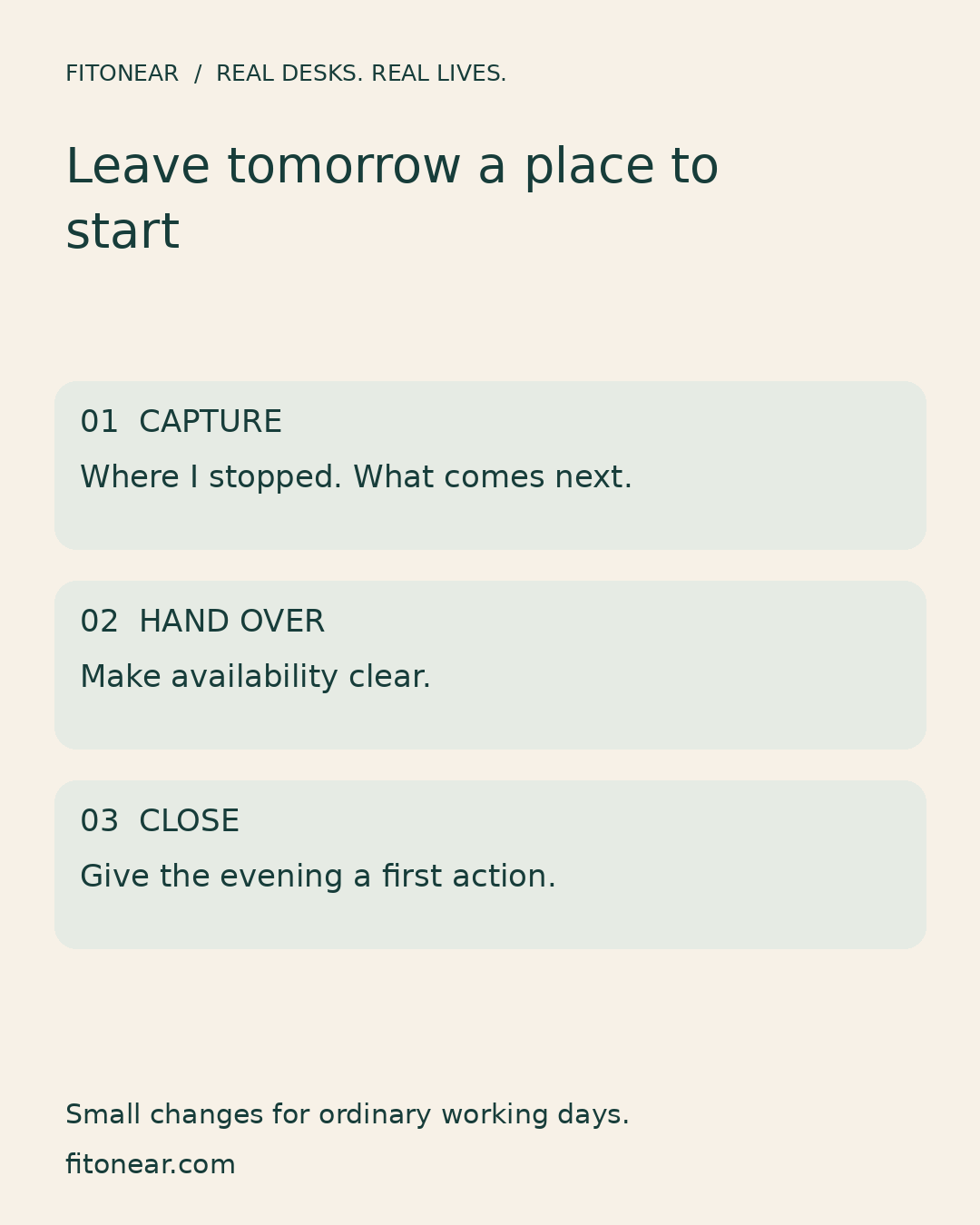
Before you close the main task, leave three short lines: where you stopped, the next physical action, and anything you are waiting for.
For example: “Report totals checked through September. Next: compare October entries with the export. Waiting for Sam’s revised figures.” This is an illustrative example, not a reader’s story. It is more useful than “finish report,” because tomorrow’s version of you can begin without reconstructing the whole afternoon.
Store the note in an approved work system if it contains confidential information. A personal notebook is not automatically an appropriate place for client or company details.
Separate a thought from a new work session
When an unfinished task comes to mind, you may only need to capture it. You don’t always need to reopen the document, check the inbox and discover three more jobs.
Use one place for these reminders. A short approved task list is enough. Avoid making a second elaborate planning system that becomes another thing to maintain. If a reminder needs action tonight, name the reason and decide consciously, rather than drifting back into work.
Make availability explicit
A routine cannot solve unclear expectations by itself. Agree normal response hours and the route for genuine emergencies with your team. If you are on call, follow the rota and escalation process; don’t silence the channel you are required to monitor.
A useful message is specific: “I’m finishing now. The draft is saved in the shared folder. I’ll pick up the remaining checks tomorrow morning. For an urgent incident, use the agreed escalation number.” Adapt the wording to your responsibilities.
You are trying to remove uncertainty for both sides, not disappear without a handover.
Give finishing a physical shape
Save the work. Check the next action. Close or lock the device according to your workplace policy. Put the notebook away. If you use a shared table, return the surface to its next purpose.
Choose a small transition that fits your life: wash your mug, step onto the balcony, change clothes, prepare tea, or ask someone how their day went. You do not need a perfect evening routine. You need an action you can recognise as the beginning of something else.
Try a short version on a difficult day
Some evenings arrive with an unfinished incident, a late meeting or a child who needs attention immediately. Use the smallest workable version: save, leave one next-action note, and make your availability clear.
If you genuinely need to return later, define the task and an intended stopping point. “I’ll send the corrected file after dinner” is clearer than “I’ll just catch up.” Repeated late work is also a workload conversation to have with your manager, not evidence that you failed at a ritual.
Make space during the day, too
Finishing can feel harder when every pause has already been swallowed by the screen. Plan changes of activity and screen breaks within the working day where your role permits. HSE’s work-routine guidance discusses breaks and changes of activity; use your employer’s arrangements and the requirements that apply where you work.
If you like timed focus blocks, our Pomodoro guide can help you explore a structure. Treat a timer as a prompt to review your needs, rather than an order to ignore them.
Try the ritual, then simplify it
Over your next few working days, notice whether you can find your place when you return. If not, make the landing note more concrete. If checking messages pulls you into another hour of work, move that check earlier and agree a clearer finish with the team.
Do not judge the experiment by whether you never think about work again. Judge whether your notes, handover and availability are easier to understand.
You can care about your work and still let the evening begin.
Send this to someone who closes the laptop twice every night. Then decide what your own first action after work will be.
Working in a shared room? Our pack-away workspace guide can help with the physical handover.
Prepared with AI assistance and edited for this FitOnear series. The featured illustration is AI-generated editorial artwork, not a product photograph or hands-on test. The checklist graphic is an original FitOnear layout.
Sources, scope and updates
This is an original FitOnear editorial exercise informed by HSE work-routine and screen-break guidance. The household examples are illustrative, not reader testimonials or measured results. AI-generated artwork is illustrative and does not document a tested product.
Reviewed October 31, 2026: clarified audience, limits, evidence and shopping purpose. No live product price or availability is asserted. Any optional Amazon search is a category search, not an exact-product recommendation or a current offer.
Continue the Real desks. Real lives. series
Get the Pinterest pin & social images
Ready-made graphics for this article: Pinterest 1000 × 1500; Facebook/X 1200 × 630. Download an image and add your own caption, or use the share buttons to open a composer.